
You are planning the next batch of ad creatives. The ad networks show which videos got clicks and installs last time. They don't show which moment in the game makes players stay or pay, so the new ideas are guesses again.
Then a designer mentions that many paying players buy right when they meet a certain boss, after three quests. Nobody has put that boss in an ad.
This article explains the two kinds of analytics in plain words, how to find moments like that in what players do, and how to test them as creatives, not as truths.
Marketing analytics shows who arrived, product analytics shows what they did next
Marketing analytics measures your ads and campaigns. It counts impressions, clicks and installs, and what each of them cost. It answers one question well: which ad brought players in, and at what price?
Product analytics measures what players do inside the game. The game records small events as things happen: a quest finished, the shop opened, a purchase made. Each event belongs to one player, so you can follow that player's path from the first session to the first purchase.
Think of a shop. Marketing analytics counts who came through the door and which poster on the street brought them. Product analytics follows which aisle they stopped in before they bought something.
You need both. Marketing analytics is how you judge an ad. Product analytics is where good ad ideas can come from. This article is about the order: start from what players do in the game, then test that moment with marketing.
How a gameplay pattern becomes an ad hypothesis
The path from a moment in the game to a creative test runs through a few people. The developer who owns the build sends the events. An analyst, a dashboard or an AI agent finds the pattern. A designer says why it happens. You turn it into a creative and let the ad network judge it.
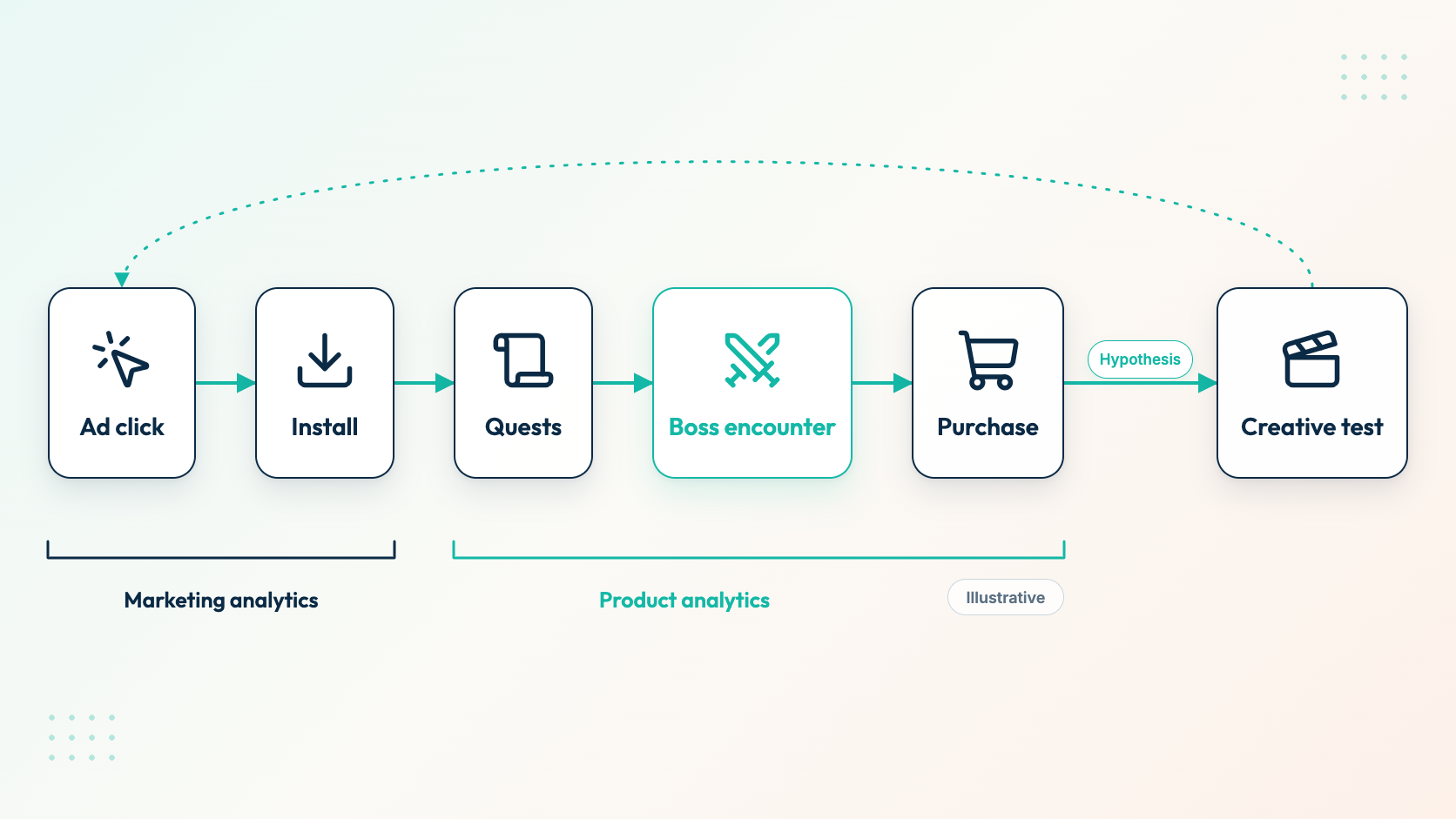
The quest and boss steps are an illustrative example, not data from a real game.
Track the moments that matter, and the purchases
You can only see a pattern the game records. If the game sends nothing when a quest ends, nobody can tell you later that payers finished three quests first. Rawbbit does not guess behavior that was never sent.
So the list of tracked moments should include the ones a marketer might want to show: quests, boss fights, new characters, the shop and every completed purchase. Each one must be tied to the same player. Without that, you have a count of quests and a count of purchases, but no way to see that one player did both.
Your designer can plan which events to track. For the developer, the Rawbbit event schema and what telemetry to send first cover the details.
Keep gameplay and purchases in one place
In many studios, gameplay data sits in one analytics tool and purchases sit in a store or payment dashboard. Each answers its own questions. Neither can tell you what a player did right before paying, because the two halves never meet.
Rawbbit collects both kinds of events from the game and stores them together, under the same player. When you self-host, the raw data sits in your own storage, not in a vendor's account.
That history matters for marketing. The boss question may come up months after launch, when you plan a new campaign. If you keep raw events you own, the answer is still there. How Rawbbit works shows the full path, and how one event moves through Rawbbit follows a single event for the technical reader.
Look at what players do before they pay
The question for the analyst is simple: what did payers do before their first purchase? A common way to answer it is an ordered funnel. It counts how many players reach each step in a set order: first quest, third quest, boss fight, purchase.
You do not have to write the query yourself. An analyst can run it and build a game-design dashboard in Metabase that you open whenever you need it. Or the team can ask an AI agent about your game data. Through Rawbbit's analytics connection, an agent can find which events the game sends and calculate ordered funnels.
This is custom analysis, not a ready-made report. Your team chooses the steps. Ask them to look a few steps back, not only at the last screen before the purchase. The shop and checkout screens come right before almost every purchase. They tell you how players pay, not what made them want to.
Ask why before you brief the creative
A sequence shows what happened before players paid. It does not show why, so treat it as a lead to test, not a verdict. Before you brief a creative, check the usual other explanations with the designer:
- The shop shows an offer at that exact point, so the offer drives the purchase, not the boss.
- The boss is a difficulty spike, and players pay to get past it. Data on levels that are too hard helps spot this.
- Few players reached the boss at all, so the pattern may be noise.
Each one changes the ad. If players pay because the fight is too hard, an ad built around it may bring in players who quit there. The designer knows what the game does at that point. The data does not.
Test the creative, then check what the new players do
Now the moment becomes a creative brief, and marketing analytics takes over. Run the new creative next to your current ones. The ad network's own reports judge it on clicks, installs and cost. Rawbbit does not replace them: it covers what players do after the install.
Then go back to the game data. Do players who arrived during the test weeks reach the boss? Do they come back? Your analyst can check D1, D7 and D30 retention for those weeks. This is a rough check, because players from other channels arrive in the same weeks. It still shows whether the moment you advertised is one new players actually reach.
Example: three quests, a boss and a purchase (illustrative)
This example is made up. It is not a customer story, and the game does not exist.
A small studio runs a fantasy RPG. The marketer asks the analyst what first-time payers did before they paid. Many of them did the same thing: they finished quest three and then started the first fight with a boss called the Warden.
The marketer takes this to the designer, who explains two things. The Warden fight introduces a new playable character. The shop also shows a starter pack on the screen before that fight.
That gives two hypotheses, not one. Players may want the new character. Or the starter pack works because it appears right before a hard fight. The marketer briefs one creative around the first: open on the Warden's reveal, show the new character's first move, end as the fight begins. The designer tests the second inside the game by moving the offer.
The creative runs next to the current best one. The ad network says which wins on installs and cost. The game data shows whether the players who arrived during the test weeks reach the Warden and come back. If the creative wins on installs but the players who arrived in those weeks rarely reach the Warden, the team looks again before putting more budget behind it.
What this changes for a game marketer
Your next creative idea starts in the game, not only in last month's click-through rates. Bring a few questions to the designer or the analyst:
- What do payers do before they pay, a few steps before the checkout?
- Which moments do players who come back reach, and which do players who leave never see?
- At which quest or level do first purchases cluster?
For the second question, it helps to know where players quit first.
The analyst runs the query. The designer says why the pattern exists. You turn the best explanation into a creative. No tool does the interpreting for you.
Watch the sample size. If only a handful of players reached the moment, keep it as a lead for later, not the basis for a campaign.
What Rawbbit does here, and what it does not
Rawbbit stores your game's gameplay and purchase events in one place, under the same player, and keeps the full history. When you self-host, that data is yours. Your team gets answers in three ways: an analyst's queries, Metabase dashboards or an AI agent. Dashboards can be built from scratch or adapted from Rawbbit's demo ones.
Rawbbit is not an attribution tool, and it does not report return on ad spend (ROAS). To judge which campaign or creative brought players in, use the ad network's own reports. There is no ready-made quest-to-purchase marketing dashboard either. The funnel in this article is something your team builds or asks an agent for.
It is infrastructure, not an app you switch on. Your team decides which moments to track, and a developer adds the events to the game. Rawbbit has SDKs for Unity and for browser games written in JavaScript.
Next step: get gameplay and purchases into one queryable place
Start with how Rawbbit works: the path from a moment in the game to an answer your team can look up. Rawbbit is open-source game analytics under the Apache 2.0 license.
Your developer can self-host it free from GitHub. If you would rather have the Rawbbit team set it up and run it, ask for a quote for a managed setup we price for your studio.
There is also a free fixed-scope design partner pilot. It covers one game, a plan of which events to track and three business questions, such as what players do before their first purchase.
FAQ
Is product analytics more important than marketing analytics for games?
No. They answer different questions. Marketing analytics judges ads and spend: clicks, installs and cost. Product analytics shows what players do after the install, which makes it a good source of ad ideas. Start ideas from gameplay data, then judge them with marketing data.
Can product analytics replace ad attribution?
No. Attribution ties an install to the ad or campaign that brought it, and that data comes from ad networks and attribution tools. Product analytics starts after the install and shows what players do in the game. You need both.
Which events do I need to see what players do before they pay?
Ask the developer who owns the build to send an event for each moment you care about, such as a quest finished or a boss fight started, and one for every completed purchase. Every event must be tied to the same player, so the analyst can see that one player did both.
Does a pattern before a purchase mean players like that moment?
No. It shows what happened before players paid, not why. An offer placed at that point, a difficulty spike or a small sample can explain it too. Ask the designer why it happens there, then test the moment as a creative.
Does Rawbbit connect to ad networks or measure ROAS?
No. Rawbbit is not an attribution or ROAS tool. It stores your gameplay and purchase events in one place you own, and your team reads them through queries, Metabase dashboards or an AI agent. Use the ad network's own reports to judge creatives and spend.