
You ask for an analytics budget in the planning meeting. The money goes to another artist or the next content update instead. A month later the founder asks where new players quit, or whether the last offer sold, and the answer is a guess or a spreadsheet.
The request lost because it sounded like technology, while the hire and the update sounded like results. This guide gives you an honest build vs buy analytics comparison, with self-hosting open source as a third path. Then it shows how to turn the request into one game decision and a small pilot your founder can say yes to.
Why analytics loses to headcount and content in a studio budget
From what we have seen, a tools budget in a CTO's hands is rare at game studios. That is an observation, not a survey result. The reason is easy to see from the founder's chair.
A new artist has a face, a portfolio and a list of assets they will ship. A content update has a date and players who will notice it. A data pipeline has neither. To a founder, it sounds like a cost the studio pays so engineers can have nicer tools.
So the fix is not to argue harder about the tool. Change what you ask for. Start from one game decision the founder already cares about. Show the full cost of each way to answer it, including your team's time. Then ask for a small, reversible pilot on one game, with a clear check for when it has paid off.
Sometimes that exercise shows your current stack is already enough. That is a fine result too.
What building analytics in-house really costs
Your engineers can build this. Many studios do. The question is what it costs in time, and the first build is the smallest part.
A working pipeline needs four pieces. You need a way to receive events from the game, storage for them, a query layer that answers questions quickly, and dashboards people actually open. Each piece is a project of its own.
Then the upkeep starts, and it never stops. Every new build of the game adds or changes events, so the data structure has to follow. Events break quietly: a renamed field, or a client that stops sending after an update. The pipeline needs monitoring, so you learn about a gap before the founder does. And when ingestion stops on a launch weekend, an engineer is on call to fix it.
The biggest cost never shows up in a budget. The engineer who maintains the pipeline is not shipping the game. At a small studio, that is often the same person who owns the backend or the build. Every week spent on analytics plumbing is a week of gameplay, tools or live-ops work that slips.
So the real trade-off is time to the first useful answer and the bandwidth of your specialists. It is not whether your team is capable.
Build, buy or self-host open source: an honest side-by-side
There are three paths: build it yourself, buy, or self-host open source. Buying comes in two forms, a packaged tool or a provider who sets up and runs a stack for you, so the table has four columns. None of them wins everywhere.
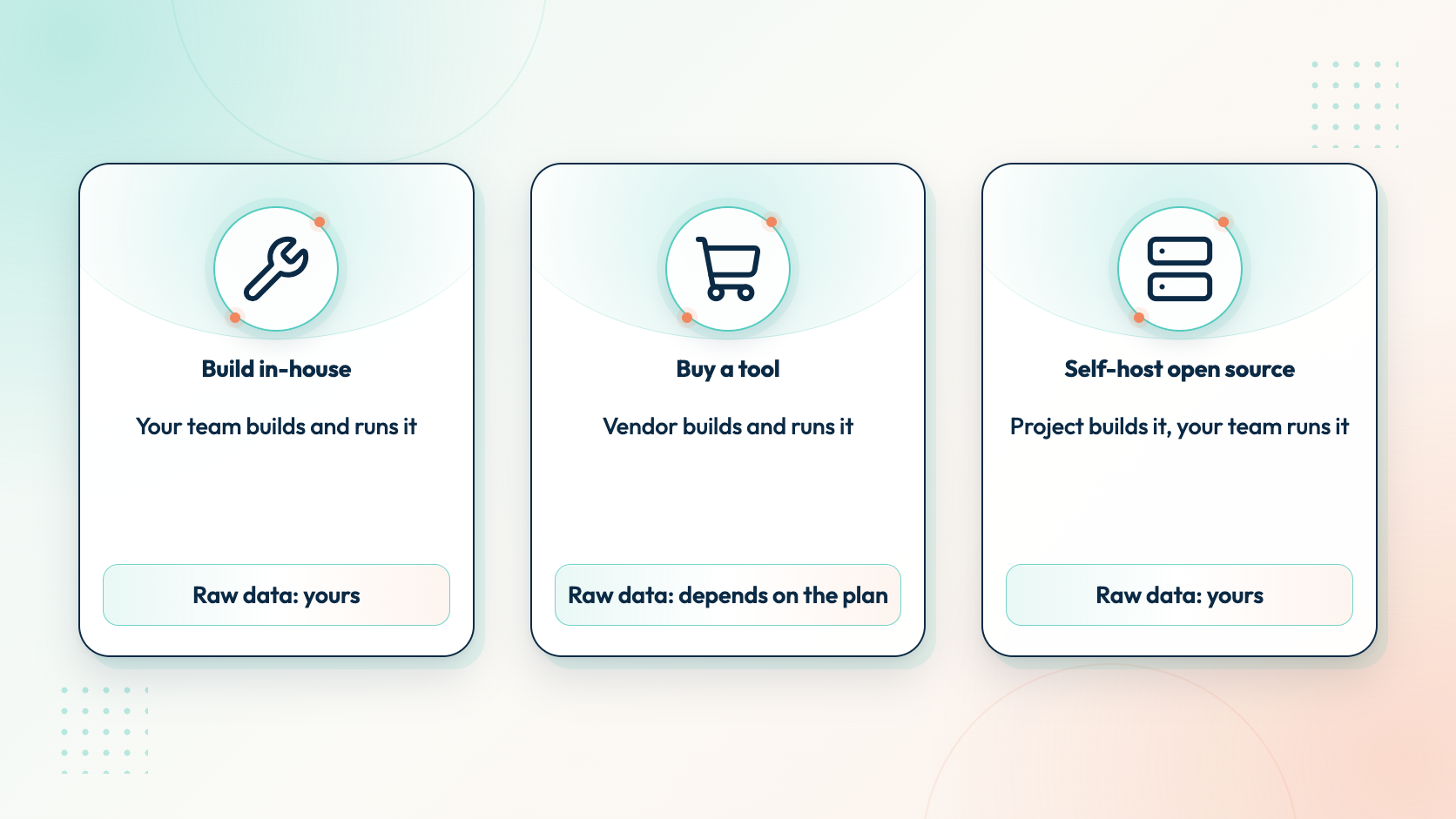
Who builds, who runs and who owns the raw data on each path.
| Build in-house | Buy a packaged tool | Self-host open source | Managed setup | |
|---|---|---|---|---|
| Who builds it | Your engineers | The vendor | The open-source project; your team deploys it | A provider, for your studio |
| Who runs it | Your team | The vendor | Your team | The provider |
| Time to first useful answer | Slowest: the pipeline comes before any answer | Usually the fastest start | After deployment and tracking | After deployment and tracking, without your engineers on the servers |
| Who owns the raw data | You | Depends on the plan | You, in your own storage | Agree it in the contract |
| Lock-in | Low, but tied to the people who built it | Higher: reports and history live in the vendor's tool | Low: open code and a raw history you keep | Depends on who owns the stack and the data |
| Ongoing work | All of it: upkeep, monitoring, on-call | Tracking, interpretation, watching plan limits | Upgrades, monitoring, disk, backups | Tracking and interpretation, plus the provider's fee |
Buying a packaged tool is the fastest start. Add the SDK, and basic reports appear soon after. The limits show up later, and they depend on the plan you pay for. Can purchases from your own store be joined to player data? Can you export the raw events, and how many per day?
On one game Rawbbit's founder worked on, the free export limit was 1M events per day. The game went over it, and the only option was to cut most of the events. Check these terms before you commit, not after. If you are weighing a specific vendor, our pages on an Amplitude alternative and a Firebase Analytics alternative show how a raw-event pipeline differs.
Self-hosting open source removes the license fee, not the work. Your team runs it. With Rawbbit, the documented setup runs on two virtual machines, with no SLA and no included game dashboards or game-metric models. An engineer on your team owns the routine: upgrading the servers and services, watching service health, logs and events waiting to be stored, keeping an eye on disk space and retention, and checking the scheduled jobs that load data. Backups and restore tests need an owner too. That is usually less than building from scratch, but it is real work.
A managed setup hands the building and running to a provider for a quoted fee. You trade money for your engineers' time. Ask what is included: a one-time implementation, ongoing operations, or both. Find out too whether each part is priced on its own.
Two jobs stay with the studio on every path. The developer who owns the build still adds tracking to the game. And a designer, producer or analyst still has to read the numbers and decide something. No tool does either for you.
Turning the request into terms a founder accepts
The pitch has four parts, and the order matters. Each part answers the question the founder will ask next.
1. Start from one game decision, not from a tool
Pick a question the founder already asks out loud. Where do new players quit? Did the last update help retention? Which offer actually sells?
A decision has a value the founder can weigh. Knowing where players quit tells the designers which levels to fix next. Reading retention curves tells you whether an update kept people playing. Comparing paying users vs MAU shows whether a smaller, paying audience is worth more than a big one. A dashboard on its own has no value the founder can see.
2. Name the minimum events and metrics that answer it
Keep the scope small. To learn where new players quit, you need only a handful of events. A player started a session, began the tutorial, finished it, started a level, then failed or finished that level. From those come one or two metrics, such as how many new players get through the tutorial.
The developer who owns the build adds the tracking. Hand them the short list, not a wish list. A short list ships in one build, so the pilot is cheap to start and easy to check. For more detail, see which events to send first and how designers can plan your events before anyone writes code.
3. Put the full cost of each path on one page
Make a single page with one column per option: build, buy, self-host and managed. Add rows for engineer time to build, monthly upkeep, tool or service fees, server costs, who is on call, and how soon the first answer arrives.
Fill it in with your own team's numbers. This article gives none on purpose. Salaries, rates and plans differ too much between studios, and a borrowed figure is only a guess about your team.
Count upkeep, not only the first build. Leaving it out is a common way an in-house build ends up looking cheaper than it is. A founder also trusts a page that shows the hidden cost of the cheap option.
4. Ask for a reversible one-game pilot with a clear check
Ask for something small: one game, a fixed scope and an end date. A founder can say yes to that without betting the year on it.
If the studio already reports numbers, from a store dashboard or a current tool, compare the pilot's numbers with them for the same days. Matching numbers build trust. A gap tells you which tracking needs fixing.
Define success as the time to the first useful answer to the question from step 1. Measure three moments: the first event arrives, the first dashboard exists, and the team first makes a decision with it. Agree in advance what counts as a useful answer.
Finally, write down the exit. What happens to the data if the studio stops? If the answer is that it disappears, the pilot is not reversible. With Rawbbit, the studio keeps its raw event history, which is why owning the raw event layer matters. Rawbbit's free one-game pilot has a fixed scope and runs up to three months, and the studio takes its raw data at the end.
Example: a mid-size studio with a cross-platform strategy game (illustrative)
This example is made up; the studio and the game do not exist.
A mid-size studio runs a live-service strategy game on mobile and Steam. It ships new seasons on a regular schedule. The founder keeps asking one thing: does a new season keep players past the first week, or do they log in, look around and leave?
Today the team cannot answer that cleanly. Mobile and Steam report in different places. Purchases sit in a separate store, so nobody can say whether players who stayed also bought the season pass.
The CTO builds the pitch around that question. The decision is how to plan the next season's content. The events are short: a player logged in, started a match, finished one, claimed a season reward, and made a purchase under the same player ID. The heart of the pitch is joining those purchases to player data across both platforms, the gap between product vs marketing analytics in practice.
Then the CTO weighs the paths. Building in-house would land on the backend engineer who also runs the season servers, the person the next season can least spare. A packaged tool would start fast, so the CTO checks two terms first: can the plan combine mobile and Steam players, and can it join purchases from the studio's own store? Self-hosting open source would keep the raw history in the studio's storage, but the team would have to run the servers through a season launch. A managed setup moves that work out, for a quoted fee.
The ask is one game, one season and a fixed scope. The check is simple. Before the next season's planning meeting, can the studio see which players stayed past the first week, and whether they bought? If the pilot stops, the raw events stay with the studio. The founder is not asked to believe in a pipeline, only to fund an answer to their own question.
When not to buy anything
Sometimes the right answer is no new spend. If your current stack already answers the questions you actually ask, keep it. A migration carries its own cost and risk.
Hold off as well if no one will look at the data. Analytics pays off only when a designer, producer or analyst reads it and changes something. Without that person, every path wastes money.
And if you already have data engineers with spare time and want full control, building in-house can be the right call. Just count the upkeep honestly.
Where Rawbbit fits, and what to do next
Rawbbit is one option among these paths, not the default answer. It is open-source game analytics under the Apache-2.0 license. Games send events over HTTPS. On the self-hosted path, raw events land in storage your studio owns. Your team then queries them with SQL, Metabase dashboards, or AI agents on your game data through a read-only MCP connection. There are no per-event or per-seat fees. For the architecture, see how Rawbbit works.
It fits two of the options above, self-hosting and a managed setup, and you can try it first with a pilot.
Self-host it free. The code is on GitHub, and your team runs it on its own servers (the documented setup uses two VMs), with the upkeep described earlier.
Managed. Rawbbit can scope implementation and ongoing infrastructure and analytics support separately, priced by quote. You can self-host free or ask for a quote, and read what a managed analytics pipeline includes.
The Design Partner pilot. It is free, with a fixed scope: one game, up to three months on Rawbbit's servers. At the end, the studio takes its raw data. Details are on the Design Partner page.
Rawbbit can set up Metabase quickly from an existing demo and adapt it to your game, so the first answer can look like a dashboard in Metabase your designers already understand. If you want to know who builds Rawbbit before you pitch it, start there.
Your next step does not depend on Rawbbit. Write the one page this week: the decision, the events, the full cost of each path, and the pilot you want. Then take that page to the founder instead of a tool name.
FAQ
Is it cheaper to build game analytics in-house than to buy a tool?
Not always. Most of the cost of building is people's time: the first build, then upkeep, monitoring and on-call for as long as the game runs. Put each path on one page with your own team's numbers, and count upkeep as well as setup, before you decide.
Is self-hosting open-source analytics really free?
The software is free; running it is not. Your team upgrades the servers, watches health and disk space, checks scheduled data loads and owns backups. The documented self-hosted Rawbbit setup uses two VMs and has no SLA, so that work sits with your studio.
What should a game studio track first to justify an analytics budget?
Track the few events that answer one decision the founder already cares about, such as where new players quit. A short list ships in one build, makes the pilot cheap to start and gives you an answer you can show.
How do I pitch analytics to a founder who prefers hiring or more content?
Pitch a decision, not a tool. Name the question, the events that answer it and the full cost of each path, then ask for a small pilot on one game with an end date and a clear success check.
What happens to our data if we stop a pilot?
Settle that before the pilot starts; if the data disappears when you stop, the pilot is not reversible. In the Rawbbit Design Partner pilot, the studio takes its raw data at the end.
When is our current analytics tool good enough?
When it answers the questions you actually ask, at a cost you accept. If you can see where players quit, whether updates help retention and what sells, keep it. Look elsewhere when a real question stays unanswered, for example because purchases cannot be joined to player data.