
The monthly UA review has a winner. One creative brought in the cheapest installs of the month, and everyone wants to put more budget behind it. It is one of those fake mobile game ads: a dramatic scene the game doesn't have, or only reaches hours in.
New players open the game looking for that scene. They get a tutorial and something else, and they close it. This guide explains why a cheap click only pays off when the first session delivers what the ad promised, and how a studio checks that with gameplay data from a test period.
Why studios run ads that show a game they don't have
The short answer for players: an ad is a test, and the test rewards cheap clicks. A UA team runs many creatives side by side. The ones that bring clicks or installs at the lowest price get more budget.
A scene that grabs attention in a feed wins that test easily. It does not matter to the test whether the scene exists in the game. A cost-per-install report has no column for "the player found what we showed them."
So the eye-catching false promise keeps winning. The bill arrives later, in the first session.
Where a cheap click turns expensive: the first session
A cheap install only pays off if the player finds the ad's promise in the first session. The price of an install is half the picture. The other half is whether that player stays long enough to be worth anything.
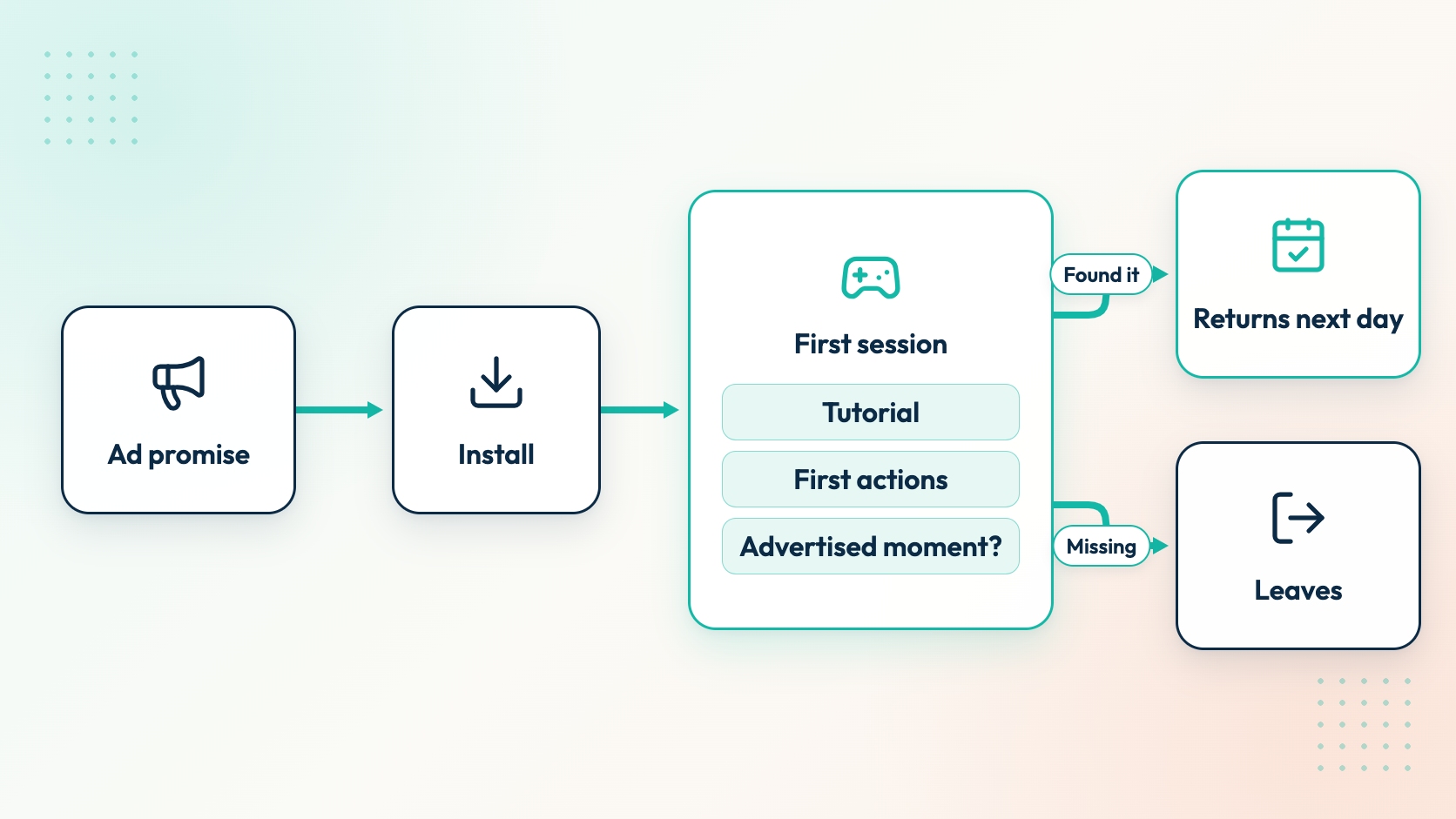
The first session is where the ad's promise is confirmed or broken.
The ad sets an expectation before the game even loads. The player arrives looking for the moment they saw. If it is missing, or hours away behind a tutorial and menus, the session ends early. That is how a cheap click becomes an expensive exit.
Cost per install can't show any of this. It stops counting at the install. Gameplay data starts there: what the new player did, how far they got, and whether they came back. For the broader split between the two kinds of data, see product analytics vs marketing analytics for game ads.
How to check whether your ad's promise survives the first session
The check has five steps, and the order matters. Each one says who does it, so a UA lead or producer can run the process without writing a query.
1. Write down the advertised moment in game terms
Turn the creative into one moment you could point to in the game. Write "the player fights a horde at the wall," not "exciting action." A vague promise can't be checked. A concrete one can.
Then answer two questions. Does the game have this moment at all? And when can a brand-new player reach it: in the first minutes, after the tutorial, or days later? If you are not sure about timing, ask the designer who owns the early game.
The marketer or producer does this step. It takes one short note per creative, and it often settles the question before any data comes in.
2. Make sure the game reports that moment and the first session
Without data on the advertised moment, nobody can say whether new players reach it. The developer who owns the build adds or confirms events for three things: a session starting, the tutorial steps, and the advertised moment itself. If the moment does not exist in the game, the session and tutorial events still show where new players stop.
Each event also needs to say which player and which session it belongs to. Rawbbit doesn't create player or session IDs. The game sends them. Without them, one new player's first session blurs into everyone else's.
Your developer can find a starting list in which events to send first. A designer can plan your events with an AI assistant before the developer adds them.
3. Mark the new players from a test period
Next, separate the players who arrived while the creative ran. The simplest way is a test window. The UA marketer writes down the days the creative ran. The analyst then groups the new players who first appear in the gameplay data during those days.
Rawbbit is not an attribution tool. It doesn't know which ad a player saw. It keeps the gameplay events your game sends. Your attribution tool stays the source for which campaign brought which install.
That makes the window a rough group, and it pays to be honest about it. If other campaigns ran on the same days, the group is mixed. Pick a window where this creative carries most of the new traffic, and note everything else that ran.
4. Look at what new players actually do in session one
Now make the first session visible. Three questions do most of the work:
- What do new players do first?
- How many of them reach the advertised moment?
- Where does the session end?
The analyst or developer builds this view. Rawbbit connects a blank Metabase to your data, and studios build their own views in it, with help from Rawbbit's team if they want it. The steps look much like building a dashboard in Metabase for a designer.
Another route is to ask an AI agent. A developer connects the agent to the data over MCP, a standard way for AI tools to reach data, here with read-only access. The team then asks its questions in plain words. Check the agent's answers the way you would check a new analyst's work.
5. Check whether they come back
Coming back the next day is the second test of the promise. A player who found the advertised moment has a reason to return. A player who looked for it and gave up usually doesn't.
The analyst compares next-day return for the test group with earlier groups of new players from the same game. Your own past groups are the fair baseline, not a number from another game. Reading D1, D7 and D30 retention explains how to read those curves.
Example: two creatives for a survival base-building game (illustrative)
This example is made up; the game does not exist. A small studio makes a mobile survival base-building game. Players gather wood, build walls and defend their base from night attacks. The UA team tests two creatives in separate weeks.
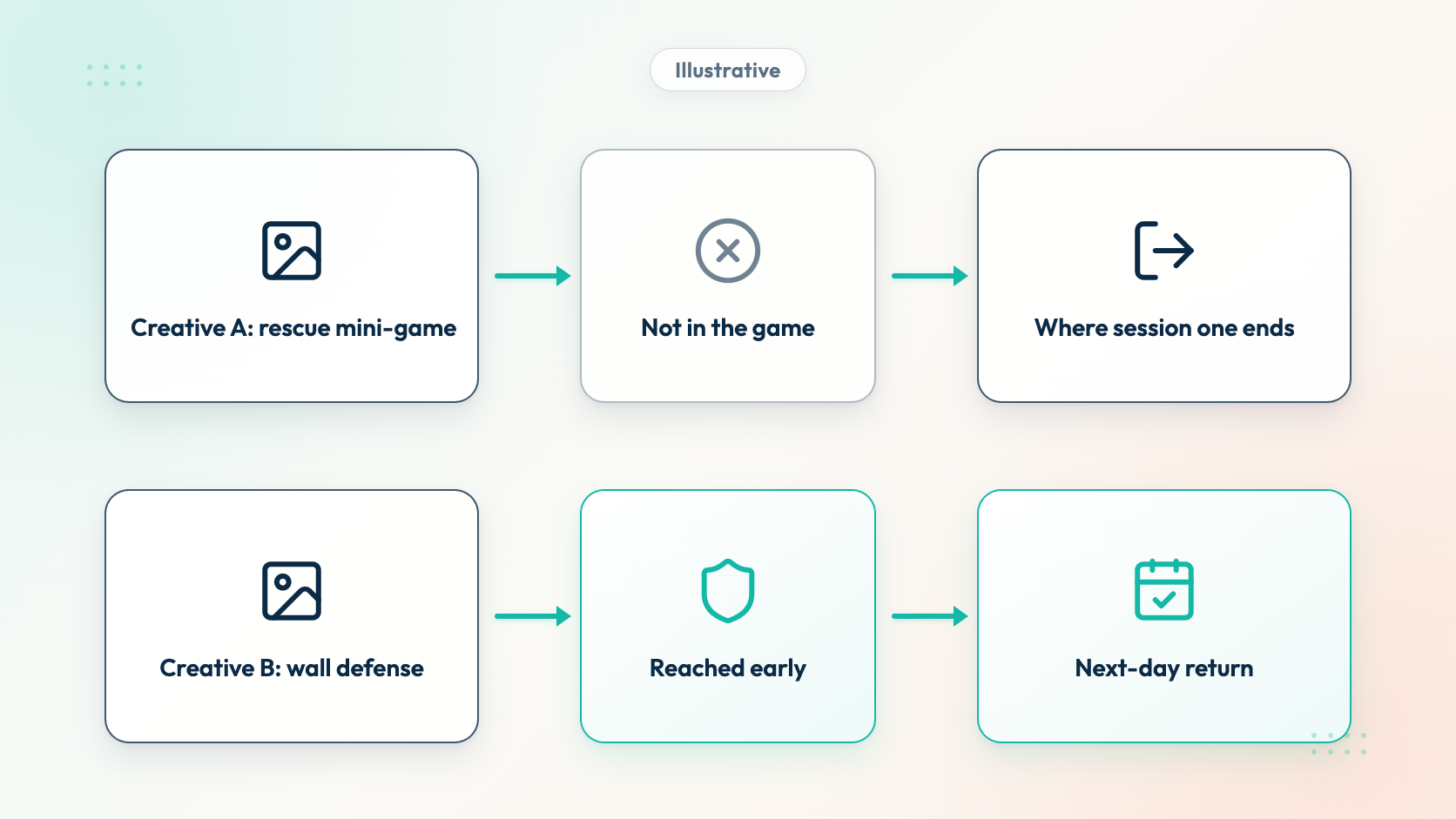
A made-up example: what the team checks for each creative's group of new players.
Creative A shows a rescue mini-game: pull the right lever and save a trapped survivor. The game has nothing like it. Creative B shows the real wall defense, which a new player reaches right after the tutorial.
In step 1, the producer writes down both moments. For A, the answer is "not in the game." For B, it is "reached early, after the tutorial." In step 2, the developer confirms that sessions, tutorial steps and the first wall defense are all reported.
For group A, the team can't count anyone reaching the advertised moment, so it looks at where session one ends. If many players leave during the tutorial or soon after it, that fits players who came for a puzzle and found a builder. The team then checks next-day return against earlier groups of new players.
For group B, the team asks how many players reach the first wall defense in session one. It also asks whether those players come back the next day more often than players who left before it.
The team uses what it sees as input for its next creative test. It might try a version of A that ends on the real wall defense. Or the designer might move the first attack a little earlier, so more new players reach it.
What this check can't tell you
A sequence of events is not proof of cause. Players leave for many reasons: a slow phone, a bad moment to start a game, or a genre they simply don't like. The check shows a pattern worth acting on, not a verdict on the ad.
The groups are only as clean as the test period. When several creatives run in the same window, you can't separate their players with gameplay data alone. Small test groups give weak signals too, so a few dozen new players is a hint, not an answer.
The data also doesn't decide anything by itself. The UA lead and the designer still read the result together and choose the next test.
Keeping gameplay events where marketing and design can both use them
This check needs gameplay events in one place, kept long enough to compare one test group with the last. Rawbbit is open-source game analytics infrastructure that does this job. It keeps your raw gameplay events in storage the studio owns. Your team reaches them through Metabase, through SQL written by the analyst, or through AI agents connected over MCP.
It sits next to your attribution tool and doesn't replace it. The attribution tool says where installs came from. Rawbbit holds what those players did once they were in the game. Why it helps to keep the raw events is its own post, and how Rawbbit works shows the whole setup.
There are three ways to start. Your developer can self-host it free from GitHub. We can run a managed setup priced for your studio, with no per-event or per-seat fees: self-host free or ask for a quote. Or apply for the free Design Partner pilot: a fixed-scope pilot for one game, up to three months on Rawbbit's servers, after which the studio takes its raw data. A first-session check of an ad's promise can be one of the pilot's business questions, once we agree on the question and the events.
Start with step 1 today. Write down the moment your best-performing creative promises, and ask your designer when a new player reaches it.
FAQ
Why do mobile games use fake ads?
Ads are judged by how cheap their clicks or installs are. A dramatic scene that is not in the game can win that test, because it catches the eye in a feed. The cost shows up later, when new players don't find what they saw and leave.
Is a low cost per install always a good sign?
No. A cheap install only pays off if the player stays. Check what new players from the test period do in their first session, whether they reach the advertised moment, and whether they come back the next day.
Can Rawbbit tell which ad a player saw?
No. Rawbbit is not an attribution tool. It keeps the gameplay events your game sends. Your attribution tool stays the source for which campaign brought which install, and the analyst groups new players by the days a creative ran.
Who at the studio sets up the first-session check?
The marketer or producer writes down the advertised moment. The developer who owns the build makes sure the game reports sessions, the tutorial and that moment. The analyst builds the view in Metabase, with help from Rawbbit's team if the studio wants it.
What if the advertised moment is in the game but comes late?
Then many new players won't reach it in their first session. Check how many do. The designer can move the moment earlier, or the UA team can advertise a moment new players reach early.
Does a drop after the first session prove the ad was the problem?
No. Players leave for many reasons, and a sequence of events is not proof of cause. Treat the drop as a signal for your next creative test, and compare against earlier groups of new players from the same game.