
It's the Monday live-ops review for your idle game. The weekend sale just ended, and revenue and installs are both up.
Then your monetization lead points out that ARPDAU went down. Did the sale fail?
This guide explains what ARPDAU says about a single day. It shows how to read it next to ARPU and ARPPU without counting the same money twice, the four things that move it, and what your game has to send so you can see it.
ARPDAU in plain words: one day's revenue split across that day's players
ARPDAU stands for average revenue per daily active user. Take one day's revenue, purchases plus ad revenue, and divide it by the number of players who were active that day. That's the whole formula.
A daily active user, or DAU, is a player who played the game on that day. Teams set their own rule for what "played" means. What counts as a daily active user covers how to pin it down.
Think of a café. At closing time the owner divides the day's takings by the number of customers who came in. That figure says nothing about people who visited last month. It describes today's customers and today's till. ARPDAU does the same for your game.
Both kinds of revenue go into the number. In a free-to-play game, most players never buy anything, but many of them watch ads. Count only purchases, and a day when players watched far more rewarded ads looks flat. Leave out purchases instead, and a successful sale disappears. Put both in, and label the chart so everyone knows what it includes.
Why games track revenue per daily player instead of per month
Live-ops work happens in days. A limited-time event runs over a weekend. A sale lasts three days. An update ships on a Tuesday. Each of these shows up as a change over a few days, and a monthly average smooths it away.
The denominator helps too. ARPDAU divides only by the people who played that day. Players who installed months ago and never came back don't water it down. So when the number moves, it moves because of the players you actually had.
The catch is noise. A single day can swing because of one big purchase or a quiet holiday. Don't compare Sunday with Monday. Compare Sunday with earlier Sundays, or look at a run of days, so the weekly rhythm doesn't fool you.
ARPDAU, ARPU and ARPPU side by side, without double-counting
The three metrics answer three different questions. ARPDAU asks how much the game earned per player today. ARPU asks how much each user was worth over a period. ARPPU asks how deep spending goes among the people who pay. The full definitions of ARPU and ARPPU are in ARPU and ARPPU, explained; here is how they line up.
| Metric | Revenue counted | Divided by | Period |
|---|---|---|---|
| ARPDAU | Purchases and ad revenue that day | Players active that day | One day |
| ARPU | Revenue in the period | All users in the period | A week or a month |
| ARPPU | Revenue from paying users | Paying users in the period | A week or a month |
The tricky part is that these numbers look related, so people try to combine them. Two shortcuts give wrong answers.
Averaging daily ARPDAU does not give monthly ARPU
Daily numbers count player-days, not people. A player who logs in every day of a 30-day month appears in all 30 daily denominators. In monthly ARPU, that same player counts once. So the average of 30 daily ARPDAU values describes revenue per player per day. It is not revenue per player per month, and multiplying it by 30 doesn't fix that either. To get monthly ARPU, your analyst divides the month's revenue by the month's unique users.
Adding ARPPU to ARPDAU counts payers twice
Payers already sit inside DAU. Their purchases are already in ARPDAU's revenue. Adding ARPPU on top counts the same money a second time. Read the three numbers next to each other, each answering its own question. Don't add them, and don't derive one from another.
What moves ARPDAU
Any change in ARPDAU comes from four places. Players who paid that day can become more or fewer, payers can spend more or less, ads can bring in more or less per player, and the mix of who is playing can change.
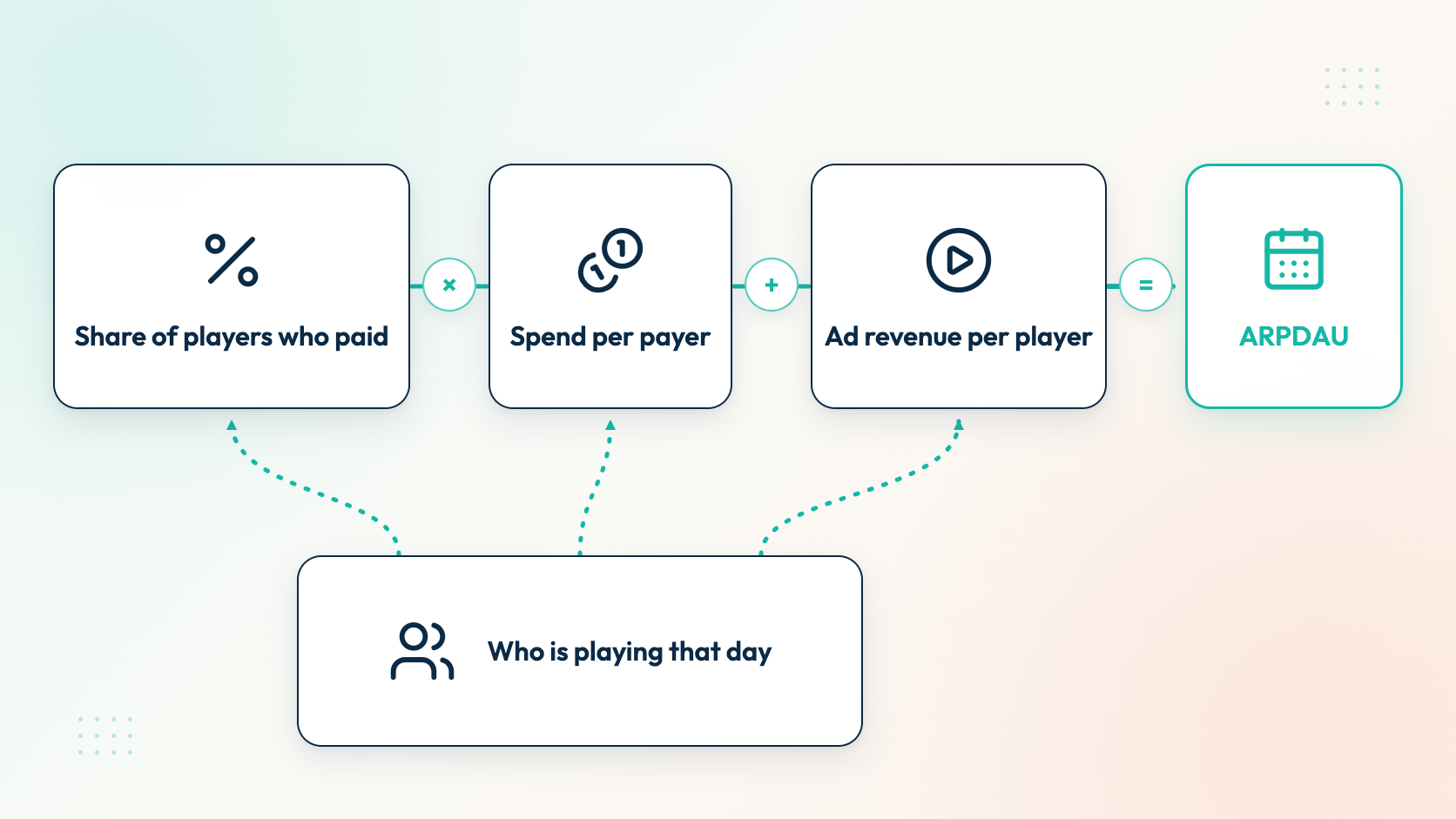
Three parts make up the number; the mix of players moves all of them.
The first three are plain arithmetic. ARPDAU equals the share of that day's players who paid, times the average spend per payer that day, plus ad revenue per daily player. The fourth driver, audience mix, works through all three at once.
This split tells you where to look. It doesn't tell you why. A drop in payer share on update day could come from the update, a holiday or a store outage. Your analyst can show which part moved. Your team still has to work out the reason.
More players paid that day
Payer share is the part that offers move most often. A starter pack, a sale or a limited-time offer gives players who never paid a cheap reason to start. When payer share rises and spend per payer falls on the same days, that is the usual pattern of a cheap offer: more payers, smaller baskets. Whether that trade is good depends on what those new payers do next.
Payers spent more each
Spend per payer moves when bundles get bigger, prices change, or a new item is worth buying in larger amounts. It also jumps when a handful of players make very large purchases on one day. Before you call a spike a trend, check whether it came from many payers or from a few.
More ad revenue per player
On the ad side, players may watch more rewarded ads because a new placement appeared or an old one got a better reward. Ad prices also change, by season and by country. Ad revenue per player can move even when players watched exactly as many ads as last week.
Ad revenue for recent days is often an estimate. The ad network can revise it later, when the final figures come in. Treat the last few days of the ad line as provisional.
A change in who is playing
A user acquisition (UA) push brings in many new players at once. Most of them don't pay in their first days. DAU grows faster than revenue, so ARPDAU falls even while total revenue rises. That is why a campaign should be judged on its own players, a point covered in product vs marketing analytics.
Weekends and holidays shift the mix too. Different players show up on a Saturday than on a Wednesday. They may pay or watch ads differently, and the number follows them.
Example: an idle mining game's sale weekend (illustrative)
This example is made up; the game does not exist. Picture an idle mining game where players dig deeper for ore. It earns from rewarded ads, which players watch to double their offline earnings, and from a starter pack in the shop.
On Friday the UA team starts a new install campaign. On Saturday the starter pack goes on sale for the weekend. By Monday, weekend revenue is above the weekend before, installs are up, and ARPDAU is down.
Now split the change with the four drivers. Among returning players, payer share went up: the sale did its job. Spend per payer dipped a little, because the starter pack is cheap. Ad revenue per player held steady, since nobody touched the ad placements. The drop came from audience mix. The campaign added many new players to DAU, and few of them paid in their first days. They lowered the average while still adding revenue.
So the answer to "did the sale fail?" is no. The two changes need separate verdicts. The sale gets judged on returning players, against earlier weekends. The campaign gets judged on its own cohort, the group of players it brought in, over the following weeks. Your analyst can follow that cohort with retention curves and its revenue over time.
Reading the number honestly: gross vs net, refunds, day boundaries, duplicates
Before anyone trusts an ARPDAU chart, agree on a few definitions with your analyst. Each one can move the number without a single player changing behavior.
Gross or net. Gross revenue is what players paid. Net is what the studio keeps after store fees and refunds. Both are valid. Pick one, write it on the chart, and keep it. Refunds arrive days later, so net revenue for past days can change after the fact.
Ad estimates or final payouts. Decide whether the chart uses the early estimates or waits for the network's final figures. Mixing the two makes recent days look different from older ones.
Where a day starts. "A day" needs a time zone. If the chart uses one time zone and your event schedule uses another, an event's first hours land on the wrong day.
Duplicate events. Events can arrive more than once. If a send fails halfway, the game sends the batch again, and the same purchase can arrive twice. Every event carries its own event ID. Your analyst makes sure each purchase is counted once by that ID before adding up revenue.
What counts as active. Use one rule for DAU, the same one as in your DAU charts. If ARPDAU counts anyone who opened the game while DAU counts only players who finished a level, the two charts won't agree.
What your game needs to send for ARPDAU in Rawbbit
ARPDAU is only as good as the events behind it. In Rawbbit, the work splits by role. The developer who owns the build sends the events. Your analyst builds the view. You and the monetization lead agree on the definitions from the section above.
The game needs three kinds of events, each tied to the player who caused it:
- A purchase event, sent when the store confirms the purchase and the player gets the item, with the amount, the currency and the player ID.
- Ad revenue, recorded with the revenue and the player ID.
- Ordinary gameplay or session events, so the analyst can count who was active that day.
The player ID is what makes the split into four drivers possible. Without it, you can see total revenue but not who paid, who watched ads, or whether they were new. For your developer, what an event carries explains the event format, and which events to send first covers the rest of a first tracking plan.
The game sends events in batches over HTTPS to Rawbbit's Collector. On a self-hosted install, the raw events are kept in storage your studio controls. That matters for ARPDAU. If you switch from gross to net later, or change what counts as active, your analyst recalculates past days from the same raw events. Keep the raw events explains why that pays off.
Your analyst then builds the ARPDAU chart in Metabase, a dashboard tool, or queries the database directly. Build the view in Metabase shows how a dashboard like this comes together. Rawbbit keeps the events and makes them easy to query. Your team still decides what counts as revenue, what counts as active, and what a change means.
Where to go from here
Next time ARPDAU moves, ask which of the four parts moved before you ask whether the change worked. Then check that the definitions held still. Often the answer is a change in who was playing.
If you want ARPDAU on your own events without running servers first, the Design Partner pilot is a free, fixed-scope pilot for one game. It runs on Rawbbit's servers for up to three months, and afterward your studio takes its raw data.
If your team prefers to run it, Rawbbit is open source under Apache 2.0, and you can self-host it for free from GitHub, with no per-event or per-seat fees. If you'd rather we set it up and run it, ask for a quote. To see the whole path from game event to dashboard, read how Rawbbit works.
FAQ
What is a good ARPDAU for a mobile game?
There is no universal benchmark worth trusting. ARPDAU depends on genre, country mix, ad setup and pricing, and published figures rarely say how they were calculated. Compare your game with its own history: the same weekdays, a similar audience mix and the same definitions.
What is the difference between ARPDAU and ARPU?
ARPDAU divides one day's revenue by the players who were active that day. ARPU divides a longer period's revenue by all users in that period, so each player counts once. ARPDAU shows today's earning power, and ARPU shows value per user over the period.
Does ARPDAU include ad revenue?
In a game that earns from both ads and purchases, it should. A purchases-only figure misses every change in ad revenue. Label the chart so everyone knows which revenue it includes.
Why did ARPDAU drop when DAU went up?
Usually because the new players pay less than the ones you already had. A UA campaign brings in players who mostly do not pay in their first days, so DAU grows faster than revenue. Total revenue can still rise. Look at the new players separately from returning ones.
Can I average daily ARPDAU to get monthly ARPU?
No. Daily ARPDAU counts player-days: a player who plays every day of a 30-day month counts 30 times across the daily figures. Monthly ARPU counts that player once. Calculate ARPU from the month's revenue and the month's unique users instead.
Which events does a game need to send to calculate ARPDAU?
Three kinds: a purchase event when the purchase is confirmed, with the amount, currency and player ID; ad revenue tied to the player ID; and ordinary gameplay or session events to count who was active. Each event also needs its own event ID so duplicates can be removed. The developer who owns the build sends them, and an analyst turns them into the ARPDAU view.